Fire May Be the Only Remedy for a Plague Killing Deer and Elk
Photo
A deer with chronic wasting disease.CreditTerry Kreeger
Mark D. Zabel wants to set some fires.
Dr. Zabel and his colleagues are developing plans to burn plots of National Park Service land in Arkansas and Colorado. If the experiments turn out as the researchers hope, they will spare some elk and deer a gruesome death.
Across a growing swath of North America, these animals are dying from a mysterious disorder called chronic wasting disease. It’s caused not by a virus or bacterium, but a deformed protein called a prion.
When ingested, prions force normal proteins in the animal’s body to become deformed as well. Over the course of months, prions can gradually wreck the animal’s nervous system, ultimately killing it.
This year is the 50th anniversary of the discovery of chronic wasting disease. In the September issue of Microbiology and Molecular Biology Reviews, Dr. Zabel, an immunologist at Colorado State University, and his former graduate student Aimee Ortega survey what scientists have learned about the slow-spreading plague.
It makes for ominous reading. “There’s a lot that we still don’t know and don’t understand about the disease,” Dr. Zabel said in an interview.
Once chronic wasting disease gets a foothold, it can spread relentlessly. It’s now documented in 24 states, and continues to expand into new ranges. In some herds, as many as half of the animals carry prions.
It’s only been in recent years that scientists have gained crucial clues to how the disease spreads. Direct contact, it turns out, isn’t the only way that the prions get from one animal to another.
Sick animals and cadavers spread prions across the landscape. Plants and soil may remain coated with deformed proteins for years, perhaps even decades. Dr. Zabel now suspects that the only way to rid the land of them is to set controlled fires.
It was at Colorado State University, in 1967, that wildlife biologists first observed some captive mule deer developing a strange new disease. The animals lost weight and awareness of their surroundings. The symptoms slowly worsened until the mule deer died.
“They’re not hard to pick out at the end stage,” Dr. Zabel said. “They have a vacant stare, they have a stumbling gait, their heads are drooping, their ears are down, you can see thick saliva dripping from their mouths. It’s like a true zombie disease.”
It wasn’t until much later that researchers discovered that chronic wasting disease belongs to a small group of conditions caused by prions. But other prion diseases are known only to affect livestock or people, not wildlife.
Scrapie, for example, is a deadly disease that afflicts sheep. A number of studies indicated that bone meal contaminated with scrapie prions passed the prions to cows. The cows developed a prion disease of their own, called bovine spongiform encephalopathy, nicknamed mad cow disease.
In rare cases, people who ate beef from the sick cows developed prions in their own brains. As of 2016, 231 people had died from the condition worldwide.
Scientists long suspected that deer and related species developed chronic wasting disease by picking up scrapie from sheep flocks kept at Colorado State University. The disease then turned up in other states and Canada as animals were shipped to private game farms. A shipment of elk to South Korea brought the plague there as well.
But Dr. Zabel now believes that the birth of chronic wasting disease may be more complicated. “I’m starting to second-guess the original hypothesis,” he said.
Prions are misfolded versions of a naturally occurring molecule called cellular prion protein. Experiments carried out in Dr. Zabel’s lab, published in January, suggest that cellular prion protein in deer and related species may be unusually prone to misfolding.
“We were able to generate a new prion,” Dr. Zabel said. “Maybe this is a spontaneous disease.”
That result might explain a startling finding last year: researchers came across a prion-riddled reindeer in Norway, the first time chronic wasting disease had been found in Europe. Since then, two more have been found, and Norway in April approved the culling of over 2000 reindeer to stop the spread.
“The jury is still out on the origin. This new outbreak in Norway just complicates the matter,” Dr. Zabel said.
Dr. Zabel and other scientists are trying to figure out how chronic wasting disease has become so successful. One factor is how the prions spread through an animal’s body. They aren’t limited to the brain in deer, elk or moose. The prions also sweep through lymph nodes and the spleen.
Get the best of Well, with the latest on health, fitness and nutrition, plus exclusive commentary by Tara Parker-Pope, delivered to your inbox every week.
As a result, Dr. Zabel and his colleagues have found, infected animals can release huge numbers of prions. “We found it in urine, in saliva and in feces,” he said. “They shed continually until they die.”
Other members of a herd can get sick by making direct contact with a shedding animal. But the way the disease is spreading across North America suggests that the prions is are also using other routes to get to new hosts.
If deer got sick only by direct contact, for example, you would expect the outbreak to be most severe in the Midwest, where populations are densest. But some of the worst outbreaks are in the Rocky Mountains, where there are fewer animals.
Mathematical models suggest that animals are getting sick from prions in the environment. In additional to the prions shed while a sick animal is alive, its cadaver can release another bounty of deformed proteins onto the ground.
Some studies suggest that these prions can end up on grass and other plants, which are then eaten by healthy animals. Some prions in the soil may bind to minerals. It’s possible that animals may sometimes pick them up if they eat bits of dirt.
Compared with viruses or bacteria, prions are impressively rugged. To decontaminate prion-covered lab equipment, scientists have to heat them to 600 degrees Celsius, or 1112 Fahrenheit.
In a forest or on a prairie, a prion may be able to hang around for years, still able to infect a new animal. As herds migrate along the same route year after year, the supply of prions in the environment may keep increasing.
“It’s starting to make sense,” said Dr. Zabel.
Scientists don’t know enough about the ecology of prions to predict how bad chronic wasting disease will become in future decades. Mountain lions and other predators may lower the infection rate by picking off sick animals as they wander away from their herds.
Scientists have also found genes that give some animals resistance to prions. It’s hoped that resistant animals will reproduce enough to main the populations of herds.
Still, Dr. Zabel worries, the supply of prions in the environment someday might push many herds past a tipping point. “That could result in herd decimation and population declines,” he said.
Dr. Zabel is also concerned about the potential threat chronic wasting disease might someday pose to humans.
So far, there have not been any documented cases in which people got sick from eating meat from sick animals. “That doesn’t mean it won’t happen,” Dr. Zabel warned.
His own experiments showing how easily cellular prion proteins can fold into a dangerous shape suggest that prions may have a potential to become more harmful. “We may just be in the early stages,” he said.
In their review, Dr. Zabel and Ms. Ortega write that researchers have found a number of ways to fight prions. Researchers have found they can rid surgical instruments of prions in an ozone bath, for example.
But such treatments are impractical in the wild. “You cannot treat half of the continental United States with ozone,” he said.
Instead, Dr. Zabel and his colleagues hope to test controlled burns. While the fires won’t be hot enough to destroy the prions, they might kill off enough prion-laden plants to lower the odds of healthy animals getting sick.
The researchers will test this hypothesis by seeing if the prevalence of chronic wasting disease drops after they set their fires.
Dr. Zabel said he has encountered some stiff skepticism about his plan. But he still thinks it is the only plausible way to put a brake on the prions.
“If you eliminate the plants that have prions on the surface, that would be a huge step forward,” he said. “I really don’t think it’s that crazy.”
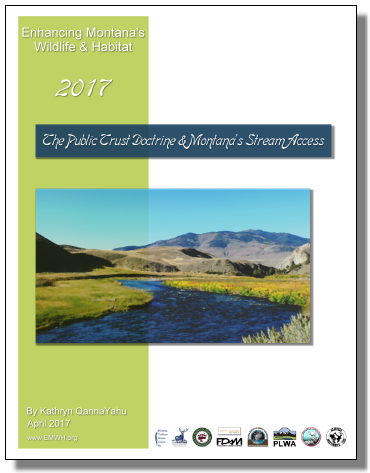
The Public Trust Doctrine & Montana's Stream Access
Folks,
Kat put together a documented history and rebuttal to the issues and
attacks sportsmen in Montana are facing recently from out of state
special interests and dark money. MSA has been one of the Montana
grassroots sportsmen groups targeted as a "green decoy". This affects
our legislative bills, stream access and our Constitution. MSA wanted to pass this along. Take a look at The Public Trust Doctrine & Montana's Stream Access report. "For over a year,
Rick Berman and Will Coggin (D.C.
special interest lobbyists) have
been attacking grassroots hunting
& angling groups, especially
Montanans, labeling them "green
decoys". During
the 2016 election, I found Montana
Supreme Court candidate, Kristen Juras'
paper against the public trust doctrine
and Montana's Stream Access; PERC
(Property and Environment Research
Center) put out an oped attacking the
Public Trust Doctrine and Montana
grassroots hunting & angling
groups. During the 2017 Legislative
session, a number of legislators
attacked the Public Trust Doctrine,
equating it with "a taking", making it
sound like a dirty word; Coggin began
emailing our legislators attacking the
local hunters and anglers that defend
our public trust; and certain special
interest legislators publicly attacked
the grassroots groups attempting to
brand them with the slanderous "green
decoy" label. Enough was enough. I had
to make time to refute all the bullshit.
Despite Juras' belief that Stream Access
is a monumental erosion of private
property; despite Sen. Jennifer
Fielder's 'fears' and lack of
understanding; the Public Trust Doctrine
is not new, it predates our US and
Montana Constitutions, and is already in
our Montana Constitution. Building on
documentation I had been accumulating, I
have spent the last couple months on
this refutation, to arm the public with
the truth about the foundation of the
public trust doctrine and our stream
access - to change the conversation.
Utilizing my pre-conservation research
background, I have woven together this
refutation history with endnotes for
veracity. Additionally, I set up a
webpage to house every piece of
documentation involved in PDF for
verifying, reading and downloading,
including Supreme Court cases and
Montana bills that go back to the
1800's.
The history provided illustrates not
only the older Public Trust Doctrine
foundation, but also examines the
present attacks, especially in Montana,
by out-of-state dark money interests and
local efforts to undermine the Public
Trust Doctrine itself, as well as the
grassroots hunting/angling
conservationists that have long defended
the public trust.
To ensure our Montana Stream Access is
here to stay, we need to educate and
equip ourselves with the Public Trust
Doctrine, defending it against private,
legislative and judicial attacks;
diligently and tirelessly challenge each
access violation, in order to preserve
our world-class, “Best in the West”,
Montana Stream Access, for future
generations.
The Public Trust
Doctrine & Montana's Stream
Access is brought to you for free
and is open access for
non-commercial use. You may
download, view, copy and print and
distribute this document as a
whole. If you would like to
contribute towards the many hours
of research and compilation, it
would be greatly appreciated, but
this is first and foremost a labor
of conservation love, to assist in
Putting the 'Public' Back In
'Public Trust'."
Secretary Ryan Zinke Department of the Interior 1849 C Street, N.W. Washington DC 20240 Dear Secretary Zinke: The Montana Sportsmen Alliance is an organization of men and women from across Montana—hunters, anglers, conservationists, hikers, river floaters, photographers and wildlife watchers, to mention a few. We subscribe to and adamantly support the fundamental proposition that our fish and wildlife, and the public lands and water that sustain them, comprise the foundation of a magnificent public legacy, a public trust and national heritage found nowhere else on earth. Woven deeply into that is the National Monument System. These sites and landscapes, including Montana’s Upper Missouri River Breaks, by virtue of their designation, allow Montanans and all Americans alike to visit and enjoy and experience those unique landscapes, regardless of social or economic status. We are very concerned with current attempts to alter, diminish and in many cases, privatize our public resources. In this case, such is taking place through the thinly veiled “review” of sites designated under the Antiquities Act. That law was passed by the U.S. Congress and signed into law by Theodore Roosevelt in 1906. It is part and parcel of numerous successive laws, acts and designations that could be viewed in sum as America’s Conservation Constitution. It was initiated with the vision and foresight of Roosevelt and many others, and carried through the last century by presidents and congresses—both Republicans and Democrats— with the full support of the American people. It has not been without controversy but each time- including the case of the Missouri Breaks National Monument- designations have prevailed and ultimately proved to be the right thing to do, both important and necessary. Yes, the Act is 111 years old but it has withstood the test of time. And as the saying goes, it’s not good because it’s old- it’s old because it’s good. You have opportunities in addressing the President’s Executive Order. You can continue on with a predictable, biased critique of these glorious places, viewing them as “open to discussion,” further wasting your and the Department of Interior’s time, not to mention our tax dollars, in a losing effort to find loopholes and deficiencies . Or, you can turn this around into a celebration of the remarkable landscapes and sites that not only distinguish and define our country and states, but are living testament to America’s commitment to Theodore Roosevelt’s magnificent conservation legacy, both for ourselves and many generations to come. It is our belief that you should take the latter trail. Thanks for your time and attention to this very important matter. Respectfully submitted Montana Sportsmen Alliance Leadership Group Joe Perry, Brady John Borgreen, Great Falls Sam Milodragovich, Butte Robert Wood, Hamilton Steve Schindler, Glasgow Jeff Herbert, Helena JW Westman, Park City
Our heralded Interior Secretary Ryan Zinke showed recently how he has no business running this important federal agency for our public lands. Zinke calls himself a Theodore Roosevelt Republican, but he is so in over his head that his utter lack of qualifications for the job could have real implications for our public lands and wildlife habitat.
Zinke fell in with the usual Republican bull about fiscal conservatism and ordered a review of all grants from Interior, including the Pittman-Robertson and Dingell-Johnson taxes. These are paid by sportsmen on guns, ammunition and fishing tackle, and they fund a big chunk of state wildlife agency budgets. The money has strict standards to ensure they benefit fish and wildlife and they have an incredible track record over the years of working to do just that.
But Zinke's brash order could screw that up. It's causing a delay of those funds, which state agencies count on. Here in Montana it could ultimately cost the FWP $20 million in lost revenue and cause us to lose the Grant Marsh habitat purchase near Hardin. These aren't regular tax dollars — these are dollars hunters and anglers have paid.
Tell that to the Navy Seal. He knows how to take orders, and he's taking them from Trump and the other cast of characters running this government. Zinke should give up his job, come home and live off his government pension before he does more damage to our public lands.