The Local Value of Wilderness
Local input is a hallmark of
democracy. Good laws should and do bubble up from neighborhoods,
country churches, and bar stools, just as bad ideas are often killed
by the folks who have to live with the results.
That’s why, if you’re running
for public office, it’s a smart idea to say that you’re in
support of local decisions. Imagine the alternative: “I’m from
the distant government and I’m here to tell you how to live your
life.” You probably wouldn’t win many votes.
But that alternative is precisely
what our lone U.S. Congressman, Greg Gianforte, did last month, when
he announced that he’s introducing legislation to remove
protections from a whole class of public land in Montana without
holding a single local meeting in the affected areas.
Specifically, Gianforte is
proposing to “release” nearly 700,000 acres of federal land in
Montana designated as wilderness study areas (WSAs) to the agencies,
the U.S. Forest Service and the BLM, that already manage the various
properties. Gianforte’s legislation is similar to that introduced
by Montana’s junior Senator, Steve Daines, but Gianforte’s goes
further, by including WSAs managed by the BLM as candidates to lose
protection.
In Valley County, Gianforte’s
bill would “release” the Bitter Creek Wilderness Study Area, some
59,000 lonely acres just south of the Canadian line roughly between
Opheim and Theony. Wilderness study areas generally, and Bitter Creek
specifically, are particularly troublesome designations. They were
designated way back in the 1970s as federal lands that exhibit some
elements of wilderness: they’re generally unroaded, they offer
pristine viewscapes and the opportunity to get away from modern
contrivances such as powerlines and compressor stations. They exhibit
most of the qualities that defined wilderness in the 1964 Wilderness
Act (and as you read this, see if it characterizes Bitter Creek): “A
wilderness, in contrast with those areas where man and his own works
dominate the landscape, is hereby recognized as an area where the
earth and its community of life are untrammeled by man, where man
himself is a visitor who does not remain.”
WSA typically don’t have the
soaring peaks or big trees or clear trout water of designated
wilderness areas, but they do have important benefits, such as
wildlife security habitat, intact native range, and accessible
contiguous public land. Most traditional uses, including grazing,
hunting, hiking, camping, and fishing, are allowed on WSAs.
These WSAs have existed in a sort
of administrative limbo for 40 years – not remarkable or remote or
sacred enough to be elevated to full-fledged wilderness, but still
cherished for their primitive nature. The “study” in their title
is part of their problem, and Gianforte isn’t wrong to address it.
They haven’t been studied for years. Instead, they exist as a sort
of thumb in the eye of folks who would like to open the land for the
full range of multiple uses. And the “study” designation isn’t
satisfying for conservationists who would like to see the wilderness
protection made permanent.
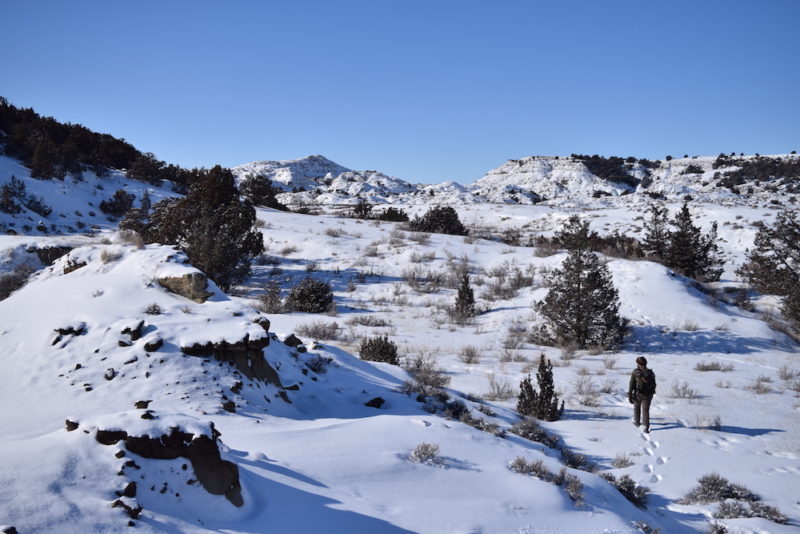
If you’ve ever hunted or hiked in
Bitter Creek, you might have experienced some of the primitive nature
that made it a wilderness candidate a generation ago. It hasn’t
changed much since then, which is sort of the point of wilderness
areas. Bitter Creek contains some of the best mule deer habitat in
the county, and it’s a favorite place for birdwatchers who
appreciate the differences between chestnut-collared longspurs and
McGowan’s longspurs, and who deeply care about the declining
populations of our native grassland birds. Its designation makes it
one of the few BLM properties that we know won’t change over the
next generation, which is a comfort as change increasingly defines
land management in Valley County.
Bitter Creek’s charms are subtle,
like the gumbo hillside encrusted with fossilized clam shells that I
found one day as I trailed a wide-racked mule deer buck miles inside
the WSA boundary. I never got close enough to that buck to make a
shot, but the hillside of shells, a relic of the Precambrian sea that
once covered what is now northeastern Montana, remains one of my
great finds in our area. The glaciers that ground down much of the
plains north of the Milk
River missed this particular knob. Finding those plate-sized
shells was like looking through a window back 100 million years.
As a wilderness area, Bitter Creek
is complicated and compromised. It is bisected by a half-dozen roads.
Enforcement of off-road travel can be lax. And its designation makes
it a target for derision. Recall the wind farm proposed for the ridge
adjacent to the Bitter Creek WSA? The industrial energy project that
was aimed at eroding local support for the WSA? The
heavily-subsidized project that was finally scrapped when it was
revealed that the development was really a front for a tax scam
propagated by a wealthy Texas speculator?
But enough about Bitter Creek. I
cherish it for its wildness and the chance it offers to discover
unknown chunks of country. Many folks look at its designation as
needless. Even the BLM concluded that it doesn’t really exhibit
enough wilderness qualities to support a wilderness area.
Should we lift the WSA designation
from Bitter Creek? Maybe so. Let’s have a discussion about it. But
that discussion is precisely what Gianforte’s bill denies us. There
have been zero opportunities for local input into the decision. I see
that the Valley County Commission has gone on record in support of
removing the WSA designation, but when did the commission solicit
their constituents’ views on the topic? As a public-land user and
advocate, I never heard about a discussion, and neither did the two
dozen other sportsmen I know who hunt Bitter Creek.
Local knowledge and wisdom is an
undervalued commodity. Input from the folks who have to live with the
decisions made by our politicians should be solicited at every turn,
not only to broaden local support for laws, but to make them better
and more livable.
If Gianforte continues to say that
he values local input, then he needs to seek it out. If he doesn’t,
then he can accurately be described as another out-of-touch
representative of the distant government telling us how to live our
lives.
Note: Montana
Sportsmen Alliance PAC The Montana Sportsmen Alliance has not
taken a stand on individual WSA's. We do not support either Gianforte
or Daines' bills eliminating them. We support local Montana voices in
having the debate on each as to their individual values! These bills
deny a voice to Montanan's. They are no different than making it all
wilderness without local input. Both Gianforte and Daines owe it to
this state to allow all voices to participate in a public process
where these decisions are vetted and made. If that takes a lot more
time, so be it!

Thursday, March 22, 2018

Tuesday, February 27, 2018
Land Board delay raises questions about conservation easements as a public access tool
by Tom Kuglin
Finding a place to hunt on the two-thirds of Montana that is privately owned can be a tricky proposition.
Whether they are a result of changing demographics, financial reasons or convenience, stories of once accessible private property being shut off recur each year. While a landowner’s right to control access remains fundamental, hunters have increasingly cited the need for access as one of the biggest threats to the future of hunting in Montana.
One of the programs the state uses to push for public access is Habitat Montana, housed under Montana Fish, Wildlife & Parks. The program is simple on its face: a portion of hunting and fishing license sales goes into an account, and FWP uses it to acquire access.
But for more than 25 years Habitat Montana, with funding going to both land purchases and conservation easements on private property, has had its critics.
“Habitat Montana has been very well intended, very well conceived and been sternly if not unanimously supported by hunters and folks who want access,” said Glenn Marx, executive director of the Montana Association of Land Trusts. “But it has also always been at some level of controversy as it’s been implemented by the department, because it allows more government management to a degree on private land. There has always been a segment of the Montana Legislature and the Montana population who has concerns about more government in more places in more ways.”
The primary criticism of Habitat Montana centers on land purchases. FWP’s acquisition of entire ranches has met resistance to growing the state’s estate. In 2015 lawmakers took away FWP’s authority to purchase more land, restricting the account to private land easements. The purchase authority was restored last year but came with a continued legislative preference for easements.
Conservation easements are a contract between a private landowner and entities such as land trusts or government agencies. Easements come in many shapes and sizes, but typically landowners agree to limit development. In exchange, landowners may receive payment and tax incentives -- the incentives a result of depreciating the value of the property by agreeing not to subdivide. Easements may contain other provisions for public access or habitat conservation, and are often touted as a means of keeping land in agriculture.
State Board of Land Commissioners
Following unanimous approval by the Montana Fish and Wildlife Commission, last week’s split-vote by the Montana State Board of Land Commissioners to indefinitely delay a decision on an eastern Montana conservation easement has raised questions about the coexistence of oil and gas development with habitat, hunting and agriculture.
Monday, February 26, 2018
MSA ALERT: All hands on deck! Horse Creek CE delayed or tabled by Land Board
Thursday, February 22, 2018
Land Board delays action on conservation easement embroiled in property rights debate
topical top storyMontana State Land BoardLand Board delays action on conservation easement embroiled in property rights debate
- Feb 21, 2018 Updated 21 hrs ago
Saturday, February 17, 2018
Keeping a way of Life: Land Near Glendive Could Get Permanent Protection, Public Access
Search and hit enter...15,000 ACRES SLATED FOR CONSERVATION EASEMENT
By Justin Schaaf
Take a hike with me if you will.
It is springtime in Eastern Montana, we are within eyesight of one of Montana’s greatest hidden treasures, Makoshika State Park.
Kip Stenson, the landowner, points us to an area across the Horse Creek bottom to begin our hike. We begin hiking from a homestead that looks as though it has sat vacant for the last fifty years. The house and outbuildings that sit on land now managed by the Bureau of Land Management tell a stark tale. A tale about a family that had invested everything and was unable to make the finances work and ultimately decided it was better to walk away from it all.Landowner Kip Stenson and the author check out a mao of the Horse Creek Easement. Photo by Hayden Clark.It isn’t long until we begin to climb in elevation as we walk through badlands from the Hell Creek Formation, riddled with sandstone hoodoos, dinosaur fossils, and other formations that could only be described by seeing with your own eyes. Our sights are set on a juniper- and cedar-crested butte on the horizon where we plan on taking a break and eating lunch.
On top of the butte we sit down under the shade of a mature cedar tree. To the north of the butte you notice the landscape transition from the rough badlands to rolling ash-timbered draws. On closer inspection you see mule deer, whitetail deer, sharptail grouse and even turkeys. As we turn our attention to the south we stop for a moment and notice a Mule Deer buck stand up out of his bed on the adjacent butte. After 10 seconds of studying, the old buck takes four bounds and disappears over the butte never to be seen again.
With our attention on the southern end of the parcel we see the landscape transition once again from the badlands down to a plateau of vast sagebrush fields. We notice a large herd of antelope in the middle of the largest field ready to stretch their legs if anything were to disturb their grazing. There has been one commonality across all the different landscapes that is impossible to overlook, this is first and foremost a cattle ranch. This is a ranch that has figured out how to make all these moving parts coincide with each other.
A GIFT TO THE FUTURE
Kip and Adele Stenson first approached Montana Fish Wildlife & Parks about the possibility of an easement on their land several years ago.
“We sat down and talked about what it might look like in the end,” Kip recalled.Photo courtesy Kip and Adele StensonThe department immediately noted the value that these thriving landscapes provided both the wildlife and people in Dawson and Wibaux Counties.
“An easement of this size can stand on its own and provide habitat and security for generations to come,” says Melissa Foster, an FWP wildlife biologist based out of Baker.
The Stensons view the easement as a guarantee into the future for local family ranching out of Eastern Montana, a departure from the trend of cattle ranching growing larger and larger while pushing local families out.
“I hope that someday my grandchildren are able to drive down the hill to our ranch and see that this land is still providing the same benefits now that it was when their grandparents were ranching it,” says Adele.
The Horse Creek easement would be funded by Habitat Montana, a program that collects funding from hunting and fishing license purchases, earmarked specifically for conservation easements; and by the U.S.Department of Agriculture.
“Considering how much hunters and fishermen contribute to conservation, I am glad they will be able to enjoy the easement for years to come,” Kip says, referring to the easement’s public access guarantee.
When the easement is completed hunters will have access to over 15,000 acres that have previously been closed to public access.
“There is no doubt a void of public access in this area and in areas where public access is difficult it only increases the strain between landowners and the department when we aren’t able to manage the wildlife within those borders,” says Foster, of FWP.Photo courtesy Kip and Adele StensonThe easement is arising from a local collaborative effort between landowners and FWP. No single party will be able to claim they won the easement, but every party involved will be able to walk away from the table pleased with the positive outcome.
For the Stensons, it provides the long-term commitment to a ranching lifestyle that Adele’s parents instilled long ago during the family’s years spent on the Rocky Mountain front. For Montana Fish Wildlife & Parks, the easement provides invaluable habitat and winter range for the wildlife in the area. For hunters, it provides hunting opportunities on almost 24 square miles of land.
“When the Montana land board meets to vote on the easement we have agreed to with the Department, I hope they keep our private property rights in the back of their mind and not what they believe we should be able to do with our property rights,” Adele says.
Ranching in Eastern Montana is the foundation of our way of life. Montana has a golden opportunity to keep the status quo.
The Montana FWP Commission gave its unanimous approval to the Horse Creek Conservation Easement Feb. 15. Next, it needs a passing vote from Montana’s Land Board, consisting of Gov. Steve Bullock, Attorney General Tim Fox, Secretary of State Corey Stapleton, Superintendent of Public Instruction Elsie Arntzen and Auditor Matt Rosendale. That vote is expected Feb. 20.
For more information on the Horse Creek Complex Conservation Easement, you can read the decision notice from the Department of Fish, Wildlife and Parks here:http://fwp.mt.gov/news/publicNotices/conservationEasements/pn_0033.html
To comment on the Horse Creek Complex Conservation Easement, you can send an email to landboard@mt.gov
Contributed by Justin Schaaf. Justin is a hunter and conservationist whose roots in Eastern Montana stretch back to the turn of the last century. After growing up in Glendive, he is now raising his young family in Fort Peck near the Charles M. Russell National Wildlife Refuge.
Got something to say to Prairie Populist? Send news tips, story ideas and comments to editor@prairiepopulist.com. If you have something to submit, or an idea for a story you’d like to write for us, check out our Submission Guidelines here.




Saturday, February 17, 2018
Keeping a way of Life: Land Near Glendive Could Get Permanent Protection, Public Access

15,000 ACRES SLATED FOR CONSERVATION EASEMENT
By Justin SchaafTake a hike with me if you will.
It is springtime in Eastern Montana, we are within eyesight of one of Montana’s greatest hidden treasures, Makoshika State Park.
Kip Stenson, the landowner, points us to an area across the Horse Creek bottom to begin our hike. We begin hiking from a homestead that looks as though it has sat vacant for the last fifty years. The house and outbuildings that sit on land now managed by the Bureau of Land Management tell a stark tale. A tale about a family that had invested everything and was unable to make the finances work and ultimately decided it was better to walk away from it all.

Landowner Kip Stenson and the author check out a mao of the Horse Creek Easement. Photo by Hayden Clark.
On top of the butte we sit down under the shade of a mature cedar tree. To the north of the butte you notice the landscape transition from the rough badlands to rolling ash-timbered draws. On closer inspection you see mule deer, whitetail deer, sharptail grouse and even turkeys. As we turn our attention to the south we stop for a moment and notice a Mule Deer buck stand up out of his bed on the adjacent butte. After 10 seconds of studying, the old buck takes four bounds and disappears over the butte never to be seen again.
With our attention on the southern end of the parcel we see the landscape transition once again from the badlands down to a plateau of vast sagebrush fields. We notice a large herd of antelope in the middle of the largest field ready to stretch their legs if anything were to disturb their grazing. There has been one commonality across all the different landscapes that is impossible to overlook, this is first and foremost a cattle ranch. This is a ranch that has figured out how to make all these moving parts coincide with each other.
A GIFT TO THE FUTURE
Kip and Adele Stenson first approached Montana Fish Wildlife & Parks about the possibility of an easement on their land several years ago.
“We sat down and talked about what it might look like in the end,” Kip recalled.

Photo courtesy Kip and Adele Stenson
“An easement of this size can stand on its own and provide habitat and security for generations to come,” says Melissa Foster, an FWP wildlife biologist based out of Baker.
The Stensons view the easement as a guarantee into the future for local family ranching out of Eastern Montana, a departure from the trend of cattle ranching growing larger and larger while pushing local families out.
“I hope that someday my grandchildren are able to drive down the hill to our ranch and see that this land is still providing the same benefits now that it was when their grandparents were ranching it,” says Adele.
The Horse Creek easement would be funded by Habitat Montana, a program that collects funding from hunting and fishing license purchases, earmarked specifically for conservation easements; and by the U.S.Department of Agriculture.
“Considering how much hunters and fishermen contribute to conservation, I am glad they will be able to enjoy the easement for years to come,” Kip says, referring to the easement’s public access guarantee.
When the easement is completed hunters will have access to over 15,000 acres that have previously been closed to public access.
“There is no doubt a void of public access in this area and in areas where public access is difficult it only increases the strain between landowners and the department when we aren’t able to manage the wildlife within those borders,” says Foster, of FWP.

Photo courtesy Kip and Adele Stenson
For the Stensons, it provides the long-term commitment to a ranching lifestyle that Adele’s parents instilled long ago during the family’s years spent on the Rocky Mountain front. For Montana Fish Wildlife & Parks, the easement provides invaluable habitat and winter range for the wildlife in the area. For hunters, it provides hunting opportunities on almost 24 square miles of land.
“When the Montana land board meets to vote on the easement we have agreed to with the Department, I hope they keep our private property rights in the back of their mind and not what they believe we should be able to do with our property rights,” Adele says.
Ranching in Eastern Montana is the foundation of our way of life. Montana has a golden opportunity to keep the status quo.
The Montana FWP Commission gave its unanimous approval to the Horse Creek Conservation Easement Feb. 15. Next, it needs a passing vote from Montana’s Land Board, consisting of Gov. Steve Bullock, Attorney General Tim Fox, Secretary of State Corey Stapleton, Superintendent of Public Instruction Elsie Arntzen and Auditor Matt Rosendale. That vote is expected Feb. 20.
For more information on the Horse Creek Complex Conservation Easement, you can read the decision notice from the Department of Fish, Wildlife and Parks here: http://fwp.mt.gov/news/publicNotices/conservationEasements/pn_0033.html
To comment on the Horse Creek Complex Conservation Easement, you can send an email to landboard@mt.gov
Contributed by Justin Schaaf. Justin is a hunter and conservationist whose roots in Eastern Montana stretch back to the turn of the last century. After growing up in Glendive, he is now raising his young family in Fort Peck near the Charles M. Russell National Wildlife Refuge.
Got something to say to Prairie Populist? Send news tips, story ideas and comments to editor@prairiepopulist.com. If you have something to submit, or an idea for a story you’d like to write for us, check out our Submission Guidelines here.
MSA ALERT: GO VIRAL Please send message to Land Board NOW!!!
This Decision will likely be made Tues. Feb. 20th. Please comment now. MSA says this is a good project! Lets see if the land board will stand behind efforts to use CE’s instead of fee title.Joe Perry
At the recent FWP Commission meeting the commission approved the Horse Creek Conservation easement in Dawson and Wibaux counties, This was a very good decision and will benefit area sportsmen. The land board of Montana now has to approve of that decision, Please send them an e mail and ask for the approval of the Horse Creek conservation easement. landboard@mt.gov it is expected this decision will be made in the next few weeks so sending them a message sooner rather than later is better.Thanks,Steve Schindler
Friday, February 2, 2018
Corrected MSA Scorecard
A review from a legislator pointed out a small mistake…..Please accept our apologies for a typo on the scorecard. The corrected version:
Joe
Sunday, January 28, 2018
Montana 2017 MSA Legislative Scorecard
http://www.montanasportsmenalliance.com/MSA%202017%20Legislative%20Scorecard.pdf
Subscribe to:
Posts (Atom)